
A Century of Community, Resilience, and Progress
For more than a century, Foam Lake has been a community built on determination, volunteerism, and a shared commitment to creating a welcoming place to live. Officially incorporated as a town on March 1, 1924, Foam Lake proudly celebrated its 100th anniversary in 2024. Yet the community’s story begins long before that milestone. To read our rich history in detail, check out Foam Lake Celebrates 100 Years of History – Written by Bob Johnson
The Beginning
The area was first settled in 1882 when Joshua and Frances Milligan established a homestead near present-day Fishing Lake First Nation. They were soon joined by other pioneer families who settled throughout the region.
The name “Foam Lake” originated in the late 1800s when early Icelandic settlers observed white foam collecting along the shores of what is now the Foam Lake Heritage Marsh on windy days. The name quickly became associated with the growing settlement.
As Saskatchewan became a province in 1905, the arrival of the Canadian Pacific Railway in June 1907 transformed Foam Lake into a thriving centre for agriculture, trade, and settlement. Businesses, hotels, grain elevators, and essential services quickly followed, and on July 15, 1909, the community was incorporated as the Village of Foam Lake with a population of just 57 residents.
Becoming a Town
Growth continued rapidly during the early decades of the twentieth century as immigrants from across Canada, Europe, the United States, and the British Commonwealth established farms and businesses throughout the district.
With expanding services and an increasing population, Foam Lake officially became a town on March 1, 1924.
Throughout the following decades, the community invested in infrastructure that continues to serve residents today. Street lighting was introduced in 1917, sewer and water services were installed in the late 1950s, dial telephone service arrived in 1963, and continual improvements to roads, utilities, and public facilities helped shape the modern community.
Building a Strong Community
Education, healthcare, recreation, and public services have always been central to life in Foam Lake.
The community’s first hospital opened in 1938 and was expanded over the following decades to meet the needs of a growing population. Today, the Foam Lake Health Centre continues to provide essential healthcare services to residents and the surrounding region.
Foam Lake’s schools have educated generations of local students. The current Foam Lake Composite School opened in 1949, while the elementary school relocated to its present location in 1977. Both schools have evolved to meet changing educational needs while remaining an important part of community life.
Recreation has also played an important role in Foam Lake’s identity. The first skating rink was built in 1916, followed by the Recreation Centre in 1967 after the previous arena was lost to fire. The community later welcomed the Central Park Swimming Pool in 1974, which was transformed into today’s Foam Lake Water Park in 2014.
Volunteer Spirit
One of Foam Lake’s defining characteristics is its remarkable tradition of volunteerism.
Perhaps no example demonstrates this better than the Foam Lake Combine Lotto. Beginning in 1995 as a fundraiser for the Recreation Centre, the lottery expanded to support the Community Hall and Golf Club. Through the dedication of hundreds of volunteers, the fundraiser has generated more than $4 million for local facilities and community improvements.
Volunteer organizations continue to strengthen every aspect of community life, supporting recreation, arts, culture, fundraising, healthcare advocacy, and countless local events.
Business and Innovation
Agriculture has always been the foundation of the local economy, but Foam Lake has continually adapted and diversified.
Today’s community supports a wide variety of retail stores, service businesses, manufacturers, agricultural suppliers, healthcare providers, and professional services.
Innovative companies such as Milligan Biofuels and Northome Windows have demonstrated Foam Lake’s entrepreneurial spirit while creating employment opportunities and contributing to the regional economy.
Culture, Heritage, and Tourism
Foam Lake celebrates a rich cultural heritage shaped by generations of settlers from many backgrounds. Icelandic, Ukrainian, and numerous other cultural traditions continue to be celebrated through community organizations, festivals, churches, music, and dance.
The Foam Lake Museum preserves the stories of early settlers through exhibits, historic buildings, and the restored Douglas House. Nearby, the Foam Lake Heritage Marsh offers internationally recognized birdwatching opportunities and showcases the area’s natural beauty, attracting visitors from around the world.
A Community Built on Resilience
Throughout its history, Foam Lake has overcome fires, floods, economic challenges, and severe weather.
From rebuilding after devastating Main Street fires to recovering from regional flooding and the 2022 tornado, the community has consistently demonstrated resilience, compassion, and an unwavering willingness to help neighbours in times of need.
These challenges have only strengthened the spirit of cooperation that continues to define Foam Lake today.
Looking Forward
Foam Lake has welcomed newcomers from across Canada and around the world, creating a diverse and vibrant community where more than 40 percent of residents are new to the area. Guided by its Good Neighbour Policy and commitment to inclusion, Truth and Reconciliation, and community well-being, Foam Lake continues to build for the future while honouring its past.
Known as the “Best Place in the World to Live,” Foam Lake remains a community where history, opportunity, volunteerism, and neighbourliness come together to create an exceptional place to call home.
As we celebrate more than 100 years of history, we honour the generations who built our community and look forward with confidence to the future still being written.
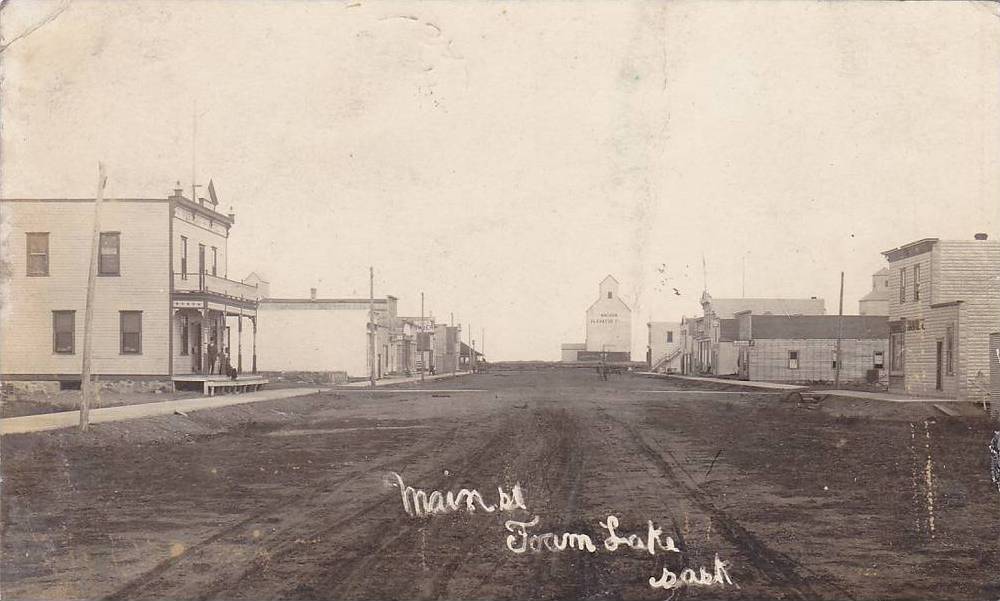
This image from 1914 and other historical images of Foam Lake can be found on the Prairie Towns website.
The Foam Lake Visitor Center, Museum, Library, and Town Office have access to the history book of Foam Lake and are called “They came from many lands”. Contact the Town Office for more information about this history book.